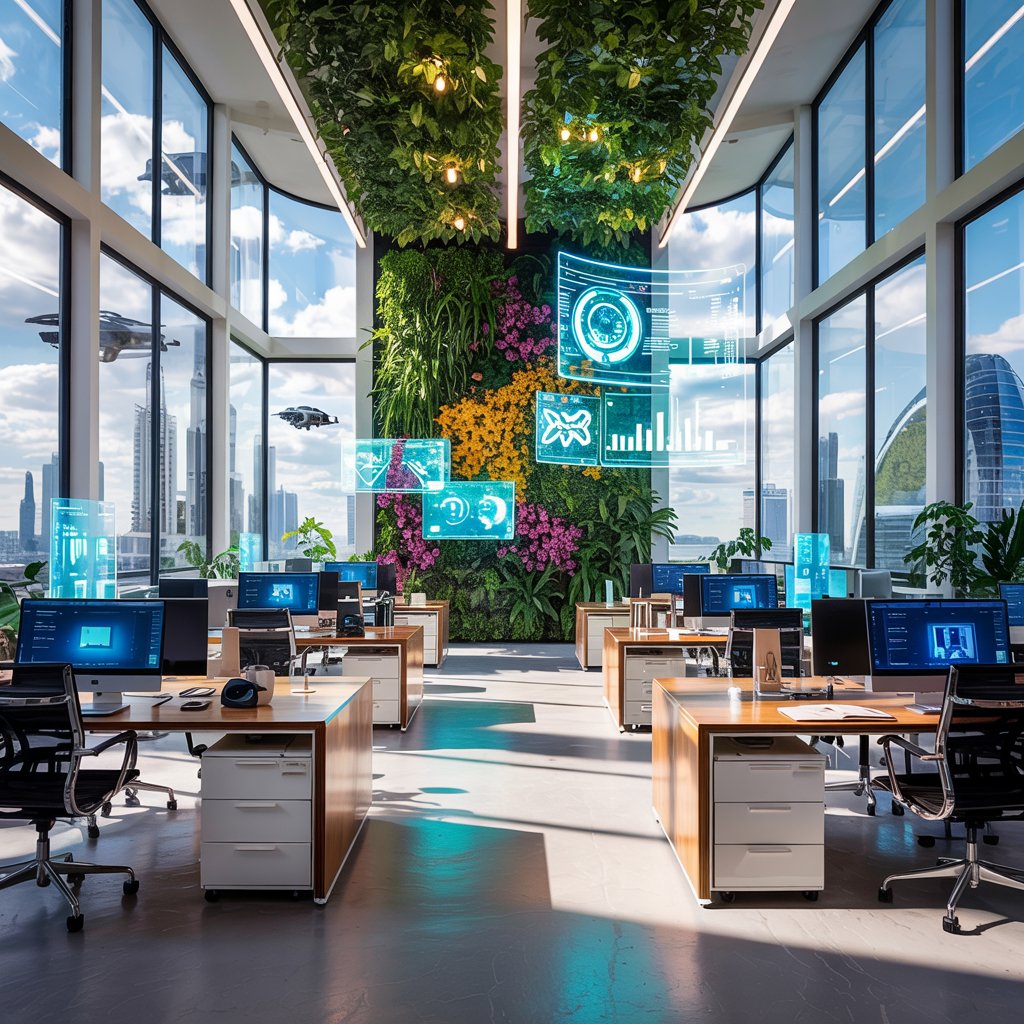
How Strategic Silence Will Define Workplace Leadership to 2030 and Beyond
The Quiet Revolution You Can No Longer Ignore
Walk through any office in central London today and you will witness a new phenomenon.
It is not loud. It is not disruptive. But it is unmistakably there.
Rows of desks sit empty long after peak commuter hours. Meeting rooms, once booked back-to-back, remain vacant for large parts of the week. Even the hum of casual conversations, once the lifeblood of office culture, has grown faint. The revolution has already happened – and it happened quietly.
This is not a sign of corporate decline, nor is it evidence of work avoidance. Instead, it signals the undeniable shift in how we work, collaborate and occupy space. Hybrid working is no longer a temporary policy or pandemic necessity – it is the embedded expectation of modern professionals.
At the same time, Environmental, Social, and Governance (ESG) obligations are becoming more stringent, pushing businesses towards net-zero targets and responsible resource management.

Perhaps most critically, invisible technology now defines workspace optimisation. From AI-driven energy systems and occupancy sensors to seamless virtual collaboration tools, today’s smartest offices are driven by platforms most users will never notice.
Yet, while this silent shift has progressed, many businesses remain rooted in yesterday’s operational mindset. They continue to pay for and maintain space in traditional ways, even as demand patterns evolve daily.
The cost is not just financial – though with London’s prime offices running at only 40–50% occupancy (Leesman, 2024), the numbers are alarming enough. The true risk lies in what this inertia signals to staff, clients and stakeholders alike.
Inaction sends a loud message, even if unintentionally. It suggests leadership that is reactive, slow to evolve and disconnected from the realities of contemporary work. Trust, once eroded, rarely returns quickly – and in professional environments where 71% of employees link workplace quality to trust in leadership (Savills, 2023), that erosion is both silent and severe.
There is a paradox at play. Today’s operational leaders will not be measured by the boldness of their renovations or the visibility of change. They will be judged on their ability to make the right adjustments quietly, seamlessly – before the cracks become too visible to ignore.
In this quiet revolution, silence has become the true marker of operational intelligence.
Operational Invisibility – The New Standard for Trust and Continuity
If the last few years have taught operations and workplace leaders anything, it is that disruption – visible or otherwise – undermines trust. Trust from stakeholders. Trust from clients. Trust, most critically, from employees themselves.
While many think of trust erosion as dramatic, the reality is much more subtle. It happens when staff walk into uninspiring spaces that no longer align with how they work. It builds when inefficient or poorly maintained environments quietly communicate leadership detachment. And it accelerates when competitor offices evolve seamlessly while yours remains static.
In this way, inaction becomes more dangerous than disruptive change. Operational silence in the face of evolving expectations sends a clear signal – and not a positive one. As workplace analyst Savills reported in 2023, 71% of UK employees directly link workplace quality to their trust in leadership.
A tired, rigid office environment does not just frustrate. It damages confidence in those responsible for shaping company culture and employee experience.
Yet the cost of inertia extends beyond perception. It is measurable, constant, and corrosive to commercial health. With each unused desk costing upwards of £60 per day in Central London (CBRE UK, 2024), poorly optimised office space silently drains budgets. Multiply that across hundreds of desks and months of underutilisation and the figure balloons into an unspoken liability – one that finance directors and shareholders inevitably notice.
Still, the greatest risk remains retention and attraction. The office today is not only a place of work; it is a strategic lever for retaining high-value talent. 85% of UK knowledge workers say they would switch employers for a better workspace experience (Leesman, 2023). What was once viewed as a functional necessity has become a competitive differentiator in attracting and keeping the best people.
The implications are clear. Operational leaders who embrace invisibility – optimising environments subtly, without disrupting flow – will protect not only financial performance but leadership reputation. Those who resist or delay face a more uncomfortable reality: falling behind, often without even noticing until trust and talent have already slipped away.
In the age of silent transformation, visible stagnation has become the loudest failure of all.
What the Smartest Offices of 2030 Will Look (and Feel) Like
The office is not disappearing. But it is quietly evolving – and the smartest organisations are already designing spaces that do not disrupt, distract, or dominate.

Instead, they support. They adapt. They operate in the background, invisible yet essential to business continuity and staff wellbeing.
For many, the perception of a future-ready office still conjures images of dramatic redesigns and technology showpieces. In reality, the offices of 2030 will be defined not by spectacle but by subtle, intuitive functionality.
At the forefront of this evolution is flexibility. The rigid, assigned desk model is already being replaced with dynamic zoning strategies. Rather than fixed spaces, offices will offer a blend of quiet zones for focus, collaborative areas for team interaction, and hybrid-ready rooms equipped for seamless video integration. These spaces will flex with daily demand – and staff will barely notice the transition.
Technology will serve this shift, but it will remain largely invisible to users. AI-driven occupancy management systems and environmental sensors will silently adjust lighting, heating, and air quality to optimise both comfort and efficiency.
Gone will be the frustration of battling for meeting rooms or navigating underutilised floors.
Instead, intelligent systems will learn usage patterns and make adjustments autonomously, creating an effortlessly smooth experience for those in the building.
Equally essential will be the integration of wellbeing principles directly into the fabric of the workplace. Organisations will quietly embed biophilic design elements, ergonomic layouts, and air purification systems to elevate mental and physical health. Many will pursue formal standards, such as WELL Certification, not for marketing purposes, but because these benchmarks drive real engagement and loyalty.
The result will not feel futuristic or cold. It will feel simple, seamless and right – an office environment so intelligently aligned with human behaviour that its sophistication becomes invisible.
This is the hallmark of the 2030 workplace. Not loud disruption or trendy gimmicks, but a silent partnership between space and people – allowing operations to flow and leadership trust to deepen without unnecessary intervention.
Invisible Group understands this philosophy intrinsically. For us, success is measured when our clients’ teams feel empowered and engaged – without ever needing to notice why.
Silent Execution – The Only Way to Future-Proof Without Disruption
While visions of the office of 2030 are inspiring, they mean little without a pathway to get there. For many organisations, the challenge is not recognising the need for change – it is executing transformation without triggering disruption. This is where true operational leadership is measured.
High-impact workplace evolution must not jeopardise business-as-usual. Clients, staff and stakeholders do not have the patience or tolerance for chaotic renovations or poorly timed rollouts. In fact, poorly managed transformations often do more harm than standing still, creating confusion, undermining productivity and eroding confidence in leadership.

The solution is not to avoid change – it is to plan it with precision. At Invisible Group, we see the route to 2030 as a phased, carefully orchestrated progression, deliberately designed to protect operational trust at every stage.
The journey begins quietly, in the background.
2025–2026 is the intelligence phase. Occupancy sensors, air quality monitors, and flexible zoning pilots are introduced to gather data without interfering with daily activities. This information becomes the foundation upon which all future decisions are based.
Next comes the integration phase.
2027–2028 is about weaving improvements into the everyday. Energy-efficient retrofits, AI-driven space management tools and WELL Silver-level wellness upgrades are implemented methodically. These steps reduce costs and enhance staff experience – all without dramatic shifts that disrupt culture or workflow.
Finally, the maturity phase arrives.
2029–2030 represents the seamless hybrid ecosystem. Augmented reality collaboration spaces, WELL Platinum certification and Net-Zero operations converge to create a workplace so attuned to human and environmental needs that it simply feels natural. No grand unveiling. No major upheaval. Just quietly executed excellence.
Throughout each stage, Invisible Group acts as the silent partner, orchestrating the process behind the scenes. Our clients – many among London’s most sensitive and demanding sectors – trust us to deliver transformation that is virtually invisible to their teams.
No downtime. No disruption. No headlines. Just operational advancement implemented with care and precision. Because in this new workplace era, real leaders are those who change everything – without anyone noticing until success is undeniable.
Move Quietly, Lead Loudly – Take the Next Step Towards Invisible Excellence
By now, one truth should be unmistakably clear. The transformation of the workplace is not something to prepare for. It is something that has already begun – quietly, subtly, and relentlessly.
Across London and beyond, organisations are evolving. Those at the forefront are not seeking attention with loud declarations or disruptive overhauls. They are making smart, strategic moves behind the scenes, reshaping their environments to meet the expectations of modern teams, regulators and stakeholders – all while protecting operational continuity.
Those who move early will secure more than just optimised office spaces. They will secure trust. Trust from leadership peers who value stability. Trust from clients who depend on uninterrupted excellence. And trust from employees who increasingly judge organisations by the environments they provide.
At Invisible Group, we understand what is at stake. Our role is not simply to execute fit outs or deliver aesthetic upgrades. It is to act as the silent partner, guiding organisations through sensitive, strategic workplace transformations without disturbing their critical operations.
We are already trusted by some of the most discerning and discreet businesses in Central London – organisations where downtime is unacceptable and reputational risk is non-negotiable. For them, and for you, we provide what others cannot: silent expertise, flawless execution and leadership-grade reliability.
The next step is not theoretical. It is practical, immediate and begins with a simple action.
If protecting your operational legacy, safeguarding your leadership reputation and embracing silent transformation are priorities, it is time to move.
Complete the Invisible Group enquiry form today to begin your confidential conversation with our expert team.In the world of 2030, success will belong to those who understood: it is not about making noise – it is about making progress that no one sees, until results speak for themselves.
Call us today!